
EU deal: battery storage permits in 6 months, not 7 years
The EU agreed on 18 November 2026 to cap permits at 3 months for solar and co-located storage and 6 months for stand-alone storage. What it means for the market, for developers and EPCs, and how to get ready.
Hannes Lipusch, Co-Founder & CTO
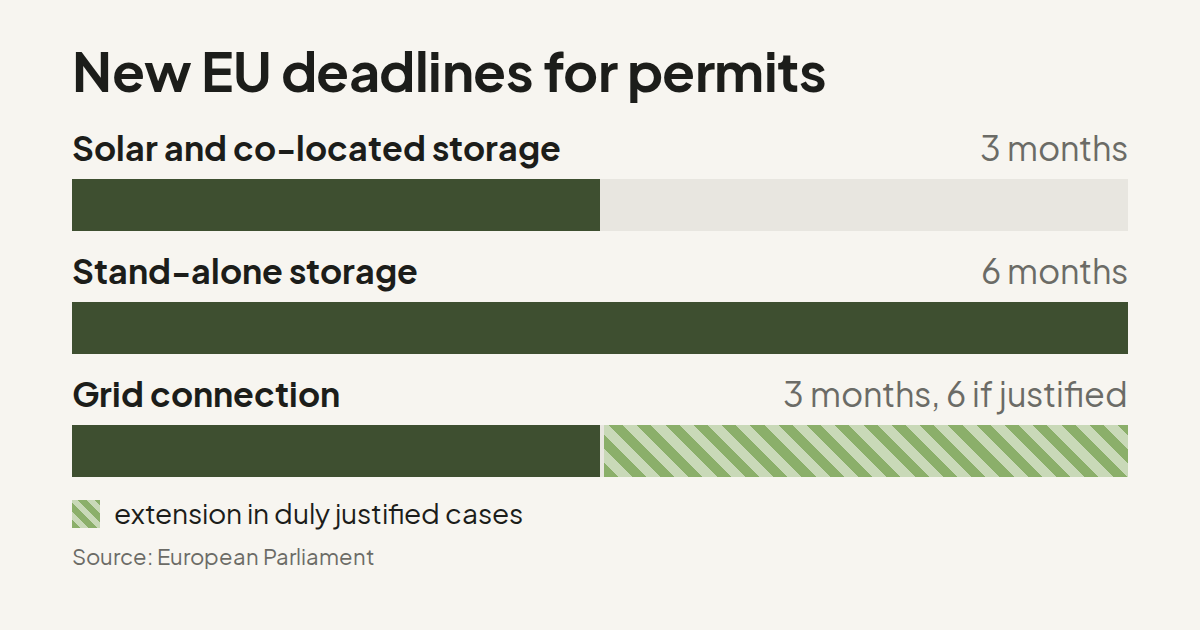
Today a storage permit in the EU can take one to seven years. Under the deal Parliament and Council struck on 18 November 2026, it takes 6 months at most for a stand-alone battery and 3 months for storage next to a solar plant (European Parliament). Years of waiting become months.
| Project | Maximum deadline |
|---|---|
| Solar energy equipment | 3 months |
| Co-located energy storage (excluding hydrogen) | 3 months |
| Stand-alone energy storage, recharging stations | 6 months |
| Pumped hydropower storage | 2 years |
| Grid connection | 3 months, 6 if duly justified |
Isolated or small connected systems, for example in outermost regions, get a derogation from the grid connection deadline.
What else the deal changes
- No permit up to 200 kW: the threshold for small solar, storage (excluding hydrogen) and recharging stations doubles from 100 to 200 kW. Recharging stations up to 1 MW on artificial structures need no permit at all.
- One portal: every member state runs one national digital portal for all permitting steps.
- Overriding public interest: renewable and grid projects are presumed to be of overriding public interest. Member states can set that aside only for cultural heritage or security and defence.
- Benefit sharing from 7 MW: projects above 7 MW, down from 10 MW, share economic benefits with their host communities. Renewable energy communities are exempt.
All from the European Parliament's release.
What it means for the market
Permits stop being the bottleneck. When an authority must decide in 6 months, a project's timeline is set by what lands on its desk: a complete, consistent application. Developers who submit faster build faster, and pipelines turn over in months instead of years.
Speed moves to the planning team. Site layout, noise, fire distances, cable routes and permit documents all have to be ready on day one, and stay consistent when the design changes. That work, not the waiting, becomes the critical path.
Grids are next. A 3 month grid connection deadline puts the same pressure on grid operators. Expect more requests, faster, and higher demand for applications that are right the first time.
What it means for you
For developers, EPCs and suppliers, the question shifts from "how long will the authority take?" to "how fast can we hand in a complete file?". That is what we build Voltplot for: Plan faster. Less risk. One platform. Change the design, and noise, the site plan, economics and permit documents update with it.
When it applies
The Parliament's industry committee (ITRE) votes first, then Parliament and Council adopt the text and it is published in the Official Journal (European Parliament). Member states then have 18 months to write it into national law (pv magazine). Projects entering design now are the ones that will land on those desks. The final text will say when each deadline starts to run and how it can be extended; we will update this post when it is out. The deal builds on the European Commission's proposal of 10 December 2025.